

If you feel like losing weight got dramatically harder after your 40th birthday, the data backs you up. We pulled together 25 science-backed weight loss statistics for women over 40 — covering menopause, metabolism, muscle, sleep, and what actually works — so you can replace myths and frustration with facts. Every number below is sourced from peer-reviewed research or public-health agencies like the CDC.
Understanding these weight loss statistics for women over 40 won’t just make you feel less alone — it will show you exactly where to focus your energy for results that last.
How Common Is Weight Gain After 40?
First, the reassuring truth: if the scale has crept up, you are firmly in the majority. These weight loss statistics for women over 40 show just how widespread midlife weight gain really is.
- 46.4% of U.S. adults aged 40–59 have obesity — the highest rate of any adult age group, above both younger (35.5%) and older (38.9%) adults, according to the CDC’s NHANES data.
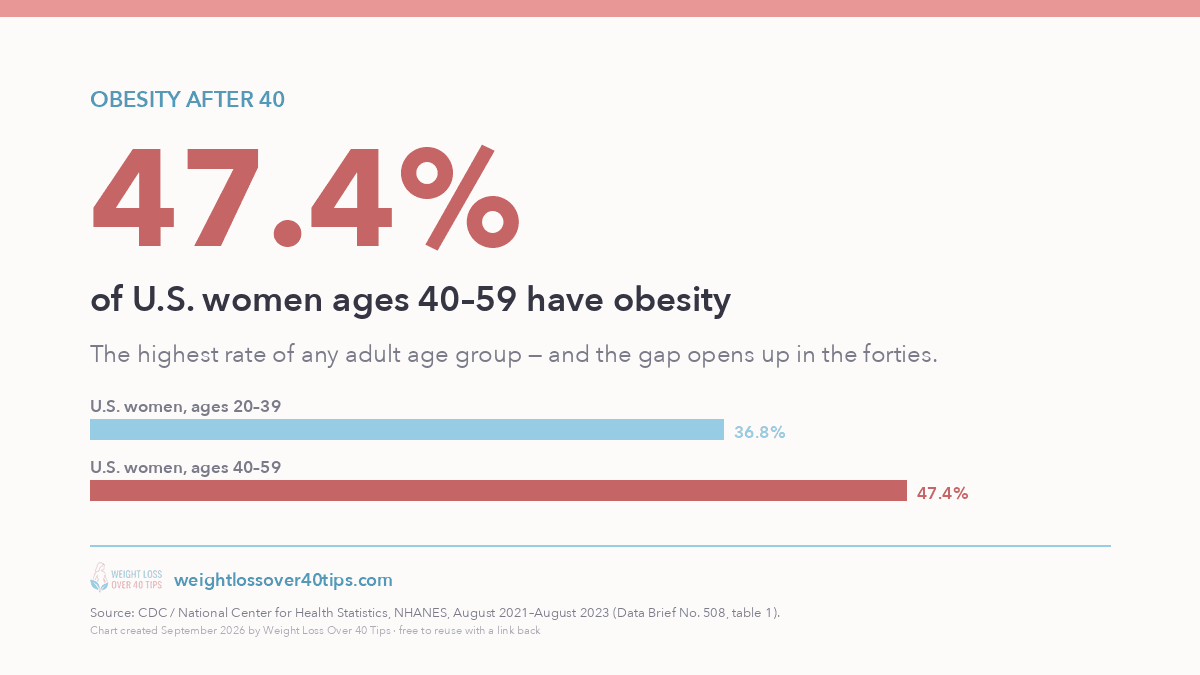
- Women aged 40–59 have a 47.4% obesity rate, compared with 36.8% of women aged 20–39 — a clear jump in midlife (CDC NHANES, August 2021–August 2023).
- Severe obesity — a BMI of 40 or higher — affects 14.7% of women aged 40–59, compared with 9.2% of men the same age, and it is the highest rate among women of any age group (CDC NHANES, August 2021–August 2023).
- Women gain about 1.5 pounds per year, on average, during the menopause transition — which, over a perimenopause lasting up to a decade, can add up to 10–15 pounds.
- In the Healthy Women Study, perimenopausal women gained about 5 pounds on average — but 20% gained 10 pounds or more, per the Obesity Action Coalition.
The Hormonal Body-Composition Shift
It’s not just how much you weigh — it’s where the weight lands. Declining estrogen changes fat storage in ways that hit the midsection hardest.
- Visceral (deep belly) fat rises from 5–8% of total body weight before menopause to 15–20% after menopause (Better Health Channel) — a major shift toward the “meno belly.”
- For the same total body fat, postmenopausal women store about 18% more visceral fat than premenopausal women, according to a study in Scientific Reports.
- As estrogen falls, fat redistributes from the hips and thighs to the abdomen, explains the Mayo Clinic — which is why waistbands tighten even when the scale barely moves.
- Excess visceral fat raises the risk of heart disease and type 2 diabetes, because it surrounds vital organs and is far more metabolically active than fat under the skin.
The Metabolism Myth, Debunked
Here’s where the biggest weight loss statistics for women over 40 will surprise you. The “my metabolism died at 40” story is mostly wrong — and understanding why points you toward the real fix.
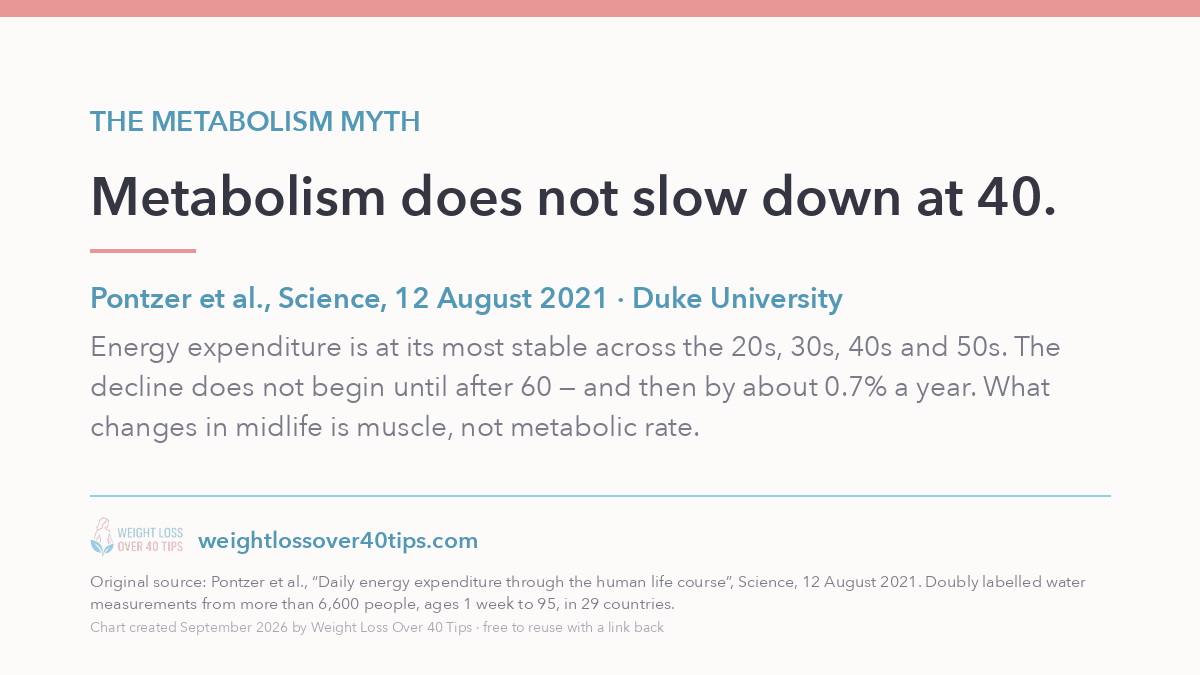
- A landmark 2021 study in Science found metabolism stays remarkably stable from ages 20 to 60 — meaning the dramatic “slowdown at 40” is largely a myth (Duke University).
- Resting metabolism doesn’t meaningfully decline until after age 60 — and then only about 0.7% per year, the same study found.
- The real culprit is muscle: women lose 3–5% of muscle mass per decade after age 30 (Office on Women’s Health), and because muscle burns more calories than fat, less muscle means fewer calories burned at rest.
- Muscle loss accelerates after menopause as estrogen declines, compounding the drop in calorie-burning lean tissue.
The takeaway: you don’t have a “broken” metabolism — you likely have less muscle. And muscle is something you can rebuild at any age.
The Activity Gap
If muscle is the answer, these numbers reveal the problem — most women over 40 aren’t doing the type of exercise that preserves it.
- Only 22.7% of women aged 35–49 meet both aerobic and muscle-strengthening guidelines — and that falls to just 17.6% of women aged 50–64 (CDC NHIS, 2020).
- Just 23.8% of women aged 45–64 meet the muscle-strengthening guideline of two sessions per week (CDC NHIS, 2020) — the exact activity that fights age-related muscle loss.
- Women are less likely than men to meet aerobic activity guidelines (42.4% vs. 52.3% in 2024, CDC NHIS), and compliance drops steadily with age.
The Sleep Connection
Sleep is the most underrated variable in these weight loss statistics for women over 40 — and the science is striking.
- Dieters who slept 5.5 hours lost 55% less body fat than those who slept 8.5 hours — on the exact same calorie-restricted diet, in a University of Chicago study.
- Short sleep also increased the loss of calorie-burning muscle by 60% in that same study — the opposite of what you want when losing weight.
- Adults who sleep under 5 hours have about 55% higher odds of obesity (meta-analysis of 604,509 adults), and poor sleep is especially common during perimenopause and menopause.
What Actually Works After 40
Now the encouraging part. These final weight loss statistics for women over 40 prove that lasting change is realistic — and they point to the specific habits that deliver it.
- About 20% of people who try to lose weight succeed long-term (losing 10%+ and keeping it off for a year or more) — hard, but far from impossible.
- 87% of National Weight Control Registry members maintained a 10%+ weight loss at both 5 and 10 years, proving durable weight loss is achievable with the right habits (NWCR).
- Combining a calorie-reduced diet with resistance training is the single most effective strategy to lose fat while preserving muscle in midlife and beyond.
- Eating 1.0–1.2 grams of protein per kilogram of body weight daily helps preserve lean muscle during weight loss — meaningfully more than the standard RDA.
- Higher-protein diets are linked to less visceral fat, a smaller waist, and greater fullness, making them a smart strategy for the “meno belly.”
- Losing just 5% of body weight significantly lowers type 2 diabetes and cardiovascular risk and improves insulin sensitivity, according to WashU Medicine — proof that you don’t need dramatic loss to transform your health.
What These Weight Loss Statistics for Women Over 40 Really Mean
Put the numbers together and a clear story emerges. Midlife weight gain is common and largely driven by hormones and muscle loss — not a lack of willpower or a “ruined” metabolism. The women who succeed aren’t doing anything magical; they’re building muscle with resistance training, eating enough protein, protecting their sleep, and staying consistent. Even a modest 5% loss delivers outsized health benefits (WashU Medicine).
If you’re ready to turn these statistics into a plan, start with our complete guide to losing weight after 40 and our science-backed breakdown of why it’s so hard to lose weight after 40.
Related reading:
- Best Weight Loss Programs for Women Over 40
- Menopause Weight Gain: Why It Happens and What to Do
- Strength Training for Women Over 40
- Sleep and Weight Loss After 40
- How to Boost Your Metabolism After 40
- Best Supplements for Weight Loss Over 40
Disclaimer: This article is for informational purposes only and does not constitute medical advice. Statistics reflect population-level research and may not apply to every individual. Always consult your healthcare provider before starting any new diet, exercise, or weight-loss program.
Get Your Free 7-Day Meal Plan
Join women over 40 getting weekly weight loss tips, meal plans, and honest program reviews.