

If the scale started creeping up in your mid-40s and nothing you used to do works anymore, you’re likely dealing with perimenopause — and perimenopause weight loss follows different rules than weight loss at 30. The good news: once you understand what’s actually driving the change, you can work with your body instead of against it. Here’s what the research shows, and what actually helps.

What Is Perimenopause — and Why Does Weight Change?
Perimenopause is the transition leading up to menopause, when estrogen levels start fluctuating and declining. It typically begins in the mid- to late-40s and lasts about 4 years on average (Office on Women’s Health) — for some women it is shorter, for others considerably longer.
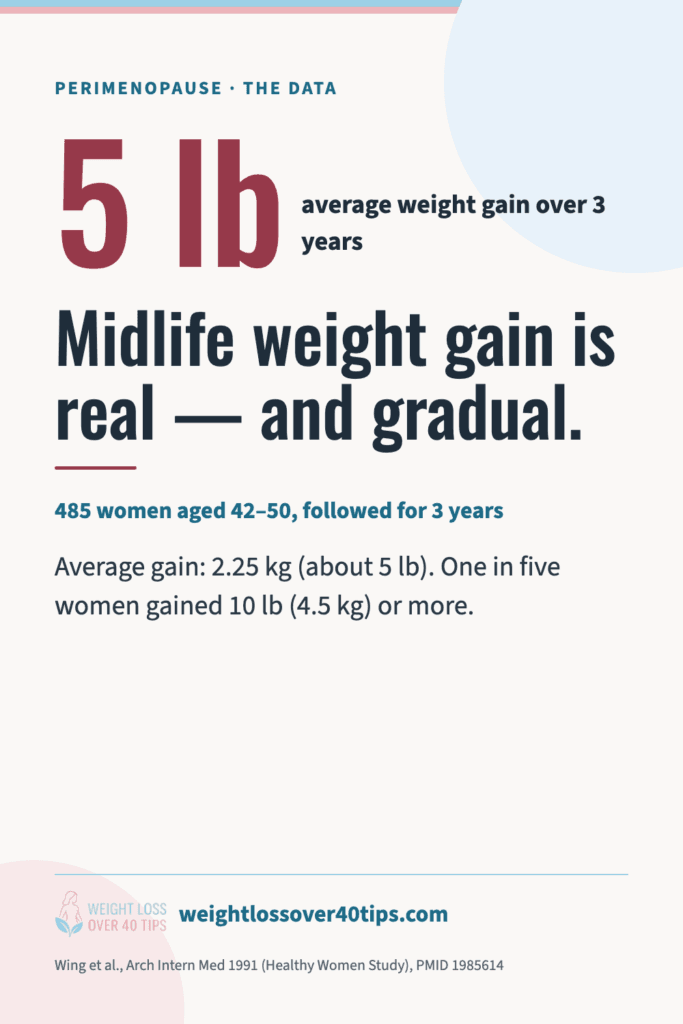
During this window, women gain roughly 1.5 pounds per year on average. In the Healthy Women Study — 485 women followed from their early 40s — the average gain was about 5 pounds over three years, and 20% of women gained 10 pounds or more. If that sounds familiar, you’re not imagining it — and you’re far from alone. Worth knowing: in that same study, women who reached natural menopause did not gain significantly more than those who stayed premenopausal, which is why researchers describe this as midlife weight gain rather than menopause itself.
Why Perimenopause Weight Loss Is Harder
Three things change at once, and they compound:
- Fat moves to your middle. As estrogen declines, fat shifts from hips and thighs to the abdomen. Visceral fat rises from 5–8% of body weight before menopause to 15–20% after (Better Health Channel) — which is why your waistband tightens even when the scale barely moves.
- Muscle loss accelerates. Women lose 3–5% of muscle per decade after 30, and lower estrogen speeds it up. Less muscle means a lower daily calorie burn — the real reason “nothing works anymore.”
- Sleep falls apart. Night sweats and disrupted sleep are among the most common perimenopause symptoms — and poor sleep directly sabotages fat loss.
Notice what’s not on that list: a broken metabolism. Research shows resting metabolism stays stable from 20 to 60 — the full picture is in our metabolism guide and the data in our weight loss statistics for women over 40.
What Actually Works for Perimenopause Weight Loss
1. Build muscle — it’s the highest-leverage move
Since muscle loss is the main driver, rebuilding it directly raises your calorie needs and protects your metabolism long-term. Two short sessions a week is enough to start — see strength training for women over 40.
2. Eat more protein than you think you need
Aim for roughly 1.2–1.6 grams per kilogram of body weight daily to preserve lean muscle while losing fat. It also keeps you full on fewer calories. Details in our guide to how much protein women over 40 need.
3. Protect your sleep like it’s a workout
Dieters who slept 5.5 hours lost 55% less body fat than those sleeping 8.5 hours — on the same diet. During perimenopause, when sleep is already fragile, this matters more than ever. See sleep and weight loss after 40.
4. Set a moderate calorie target — not a crash diet
A deficit of about 500 calories a day targets roughly a pound per week. Cutting far below that accelerates muscle loss — exactly what you don’t want now. Get your personal number with our free calorie calculator or read how many calories to lose weight after 40.
5. Manage stress and alcohol
Elevated cortisol promotes belly-fat storage, and alcohol worsens both sleep and hot flashes. Lifestyle factors — diet, activity, alcohol, stress — are the modifiable levers experts point to during this transition.
The Silver Lining: This Is Your Best Window
Health experts describe perimenopause as the ideal window for lifestyle change — the habits you build now protect your bone density, heart health, and body composition for decades. And maintaining a healthy weight can even reduce the frequency and intensity of hot flashes and night sweats. The changes that help you lose weight also make the transition itself easier.
If you’d rather follow a structured plan than piece it together, compare your options in our roundup of the best weight loss programs for women over 40, or read our honest Smoothie Diet review — the simple, protein-forward system that finally clicked for me.
Perimenopause is also when many women start looking at supplements for the first time, usually out of frustration rather than a specific deficiency. Before spending on anything, it is worth reading a sceptical breakdown — we did one in our AG1 review for women over 40, which covers what a greens powder can and cannot do for this stage.
If you would rather not build this yourself: Reverse Health puts the same principles into a structured plan and adjusts it as perimenopause progresses. The quiz is free and shows you what it would recommend for your stage. Take the free quiz → We earn a commission if you buy or sign up through our link.
Frequently Asked Questions
How much weight do most women gain during perimenopause?
About 1.5 pounds per year on average — typically 5 pounds total, though roughly 20% of women gain 10 pounds or more over the transition.
Can you lose weight during perimenopause?
Yes. It takes a different approach — prioritizing muscle, protein, and sleep over aggressive calorie cutting — but perimenopause weight loss is absolutely achievable, and even a 5% loss delivers meaningful health benefits.
How long does perimenopause last?
About 4 years on average, but it varies widely — anywhere from 2 years to a decade. It usually begins in the mid- to late-40s.
Related reading:
- Menopause Weight Gain: Why It Happens and What to Do
- Why Is It So Hard to Lose Weight After 40?
- How to Lose Weight After 40: Complete Guide
- How to Lose Belly Fat After 40
- Real Weight Loss Success Stories from Women Over 40
Disclaimer: This article is for informational purposes only and does not constitute medical advice. Perimenopause symptoms and treatment options vary by individual. Always consult your healthcare provider about hormonal changes, symptom management, or before starting any new diet or exercise program.
Get Your Free 7-Day Meal Plan
Join women over 40 getting weekly weight loss tips, meal plans, and honest program reviews.