

Wondering how to boost metabolism after 40? If you’ve been eating the same way and exercising just as much but still gaining weight, it’s natural to blame your metabolism. The research is more encouraging than that, and most of what changes is within your control.
The good news? You have more control over your metabolism than you think. Much of what feels like a slower metabolism comes from factors you can influence, such as muscle loss and moving less. This guide covers 8 practical ways to support your metabolism after 40, and it is honest about how big each effect is.
What Actually Happens to Your Metabolism After 40
Before you can effectively boost metabolism after 40, it’s important to understand what’s actually changing. Metabolism — the process by which your body converts food into energy — involves several components:
- Basal Metabolic Rate (BMR) — The calories you burn at rest, accounting for 60-75% of total daily expenditure.
- Thermic Effect of Food (TEF) — Calories burned digesting food, about 10% of intake. This stays relatively stable with age.
- Physical Activity — Calories burned through movement, both exercise and daily activities (NEAT). This often decreases as people age — not because they can’t move, but because they move less.
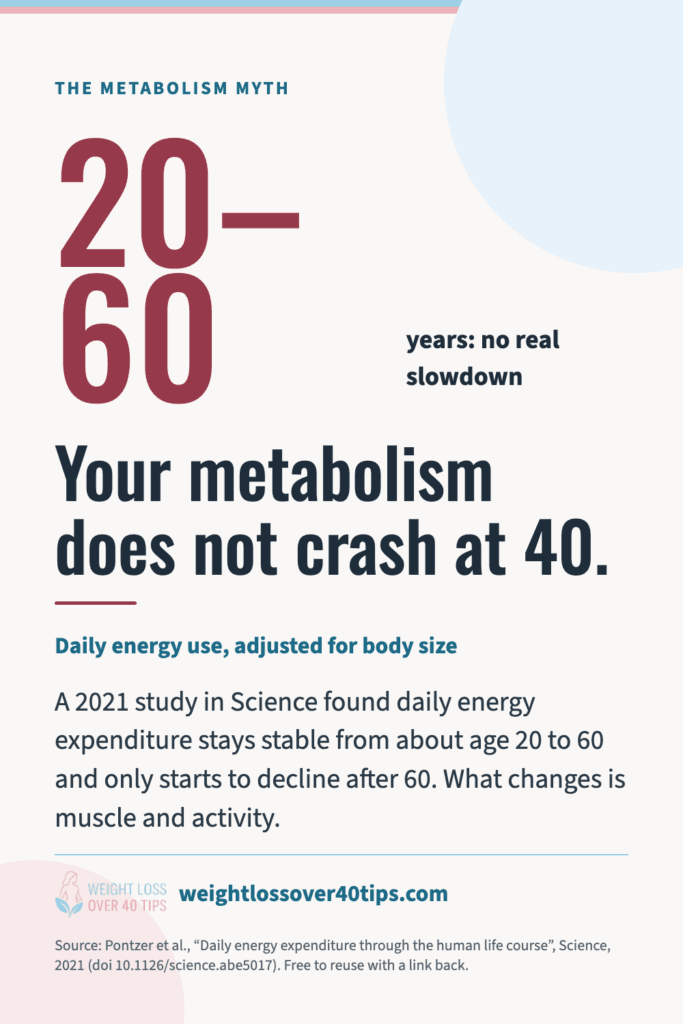
A landmark 2021 study published in Science found that daily energy expenditure, adjusted for body size, stays stable from about age 20 to 60 and only starts to decline after 60. What does change for many people is muscle mass and activity. You lose 3-5% of muscle per decade after 30, and because muscle uses more energy than fat, keeping it helps. That is why strength training and protein come first in this guide.
1. Build and Preserve Muscle Mass
Strength training is the best way to keep and build muscle after 40. Each pound of muscle uses roughly 6 calories a day at rest, compared with about 2 for a pound of fat, so adding 5 pounds of muscle raises resting energy use by only about 20-30 calories a day. The bigger benefit is keeping muscle while you lose fat.
A review in Current Sports Medicine Reports notes that 10 weeks of resistance training may increase resting metabolic rate by about 7%. The effect in calories is modest, but together with better strength and muscle it makes strength training worth prioritizing.
How to Start Strength Training
- Begin with 2-3 sessions per week, focusing on compound movements (squats, deadlifts, rows, presses)
- Use progressive overload — gradually increase weight, reps, or sets over time
- Don’t skip legs — your largest muscle groups (quads, glutes, hamstrings) burn the most calories
- Allow 48 hours between training the same muscle group for proper recovery
For a complete guide to the best workouts, see our article on exercises for weight loss after 40.
2. Optimize Your Protein Intake
Protein is the most metabolically active macronutrient. Your body burns 20-30% of protein calories just digesting it, compared to 5-10% for carbs and 0-3% for fat. This is called the thermic effect of food, and while the extra calories burned are small, protein also helps you feel full and keep muscle.
An expert group (PROT-AGE) recommends 1.0-1.2 grams of protein per kilogram of body weight per day for adults over 65, higher than the standard RDA of 0.8 g/kg, and many experts suggest similar targets for midlife women who are losing weight. For a 150-pound woman, that means 68-82 grams of protein daily.
High-Protein Foods for Metabolism
- Greek yogurt (17g per cup)
- Eggs (6g each)
- Chicken breast (31g per 4 oz)
- Salmon (25g per 4 oz — also provides omega-3s for inflammation)
- Lentils (18g per cup — great plant-based option)
- Cottage cheese (14g per half cup)
Spread your protein intake across all meals rather than loading it at dinner. In a small study, spreading protein evenly across three meals led to about 25% higher 24-hour muscle protein synthesis than eating most of it at dinner. Use our calorie calculator to determine your ideal daily calorie and protein targets.
3. Prioritize Quality Sleep
Poor sleep is easy to overlook. Sleep disruption becomes more common during perimenopause and menopause, and short sleep affects the hormones that control appetite and blood sugar:
- Leptin drops — the hormone that signals fullness decreases, making you feel hungrier
- Ghrelin rises — the hunger hormone increases, driving cravings for high-calorie foods
- Insulin sensitivity decreases — your body handles blood sugar less efficiently
- Evening cortisol can rise — which can make it harder to wind down
In a small University of Chicago study of seven young adults, four nights of 4.5 hours in bed made fat cells about 30% less sensitive to insulin. Aim for 7-9 hours of quality sleep per night.
Sleep Tips for Women Over 40
- Keep your bedroom cool (65-68°F / 18-20°C) — especially important during hot flashes
- Avoid screens 1 hour before bed (blue light suppresses melatonin)
- Limit caffeine after 2 PM, since it can stay in your system for hours
- Consider magnesium — some people find it helps with sleep; ask your doctor first
4. Stay Active Throughout the Day (NEAT)
Non-Exercise Activity Thermogenesis (NEAT) — the calories you burn through daily movement that isn’t formal exercise — accounts for 15-30% of total daily energy expenditure. And it’s one of the biggest factors you can control to boost metabolism after 40.
Differences in everyday movement can add up to hundreds of calories a day between people, often more than a single workout burns. Simple changes make a big difference:
- Take a 10-minute walk after each meal (also improves blood sugar regulation)
- Stand or pace during phone calls
- Use a standing desk for part of your workday
- Take the stairs whenever possible
- Park farther from entrances
Walking is particularly effective for women over 40 — read our complete guide on walking for weight loss over 40 to learn the optimal approach.
5. Manage Stress and Cortisol
Chronic stress can make weight management harder by affecting sleep, appetite and cravings. Managing it is worth doing for its own sake.
Perimenopause and menopause often bring extra stress and poorer sleep at the same time. Learn more about this connection in our article on menopause and weight gain.
Stress-Reduction Strategies
- Yoga or meditation — many people find these help them relax
- Deep breathing exercises — 5 minutes of diaphragmatic breathing activates the parasympathetic nervous system
- Time in nature — even a short time outdoors can help you feel calmer
- Social connection — regular time with supportive friends and family buffers stress hormones
6. Don’t Undereat — It Backfires
One of the most counterintuitive ways to boost metabolism after 40 is to eat enough. Severely restricting calories (below 1,200/day) is hard to sustain and makes it harder to keep muscle, and during weight loss the body tends to use a little less energy than expected.
Instead of dramatic calorie cuts, aim for a moderate deficit of 300-500 calories below your Total Daily Energy Expenditure (TDEE). Use our TDEE calculator to find your exact number, and our calorie calculator to set a sustainable daily target.
If you’ve been heavily restricting calories, some people prefer to increase their intake gradually back to maintenance before setting a moderate deficit, although there is little research on this approach.
7. Stay Hydrated
Staying hydrated supports energy and appetite control. One small study found that drinking 500 ml (17 oz) of water raised metabolic rate by about 30% for a short time, but later studies found much smaller effects, so think of water as helpful rather than a metabolism booster.
Cold water has a slight additional benefit — your body burns extra calories warming it to body temperature. Aim for at least 8 glasses (64 oz) per day, more if you exercise or live in a hot climate.
8. Small Habits With Modest Effects
- Drink green tea or coffee — Caffeine and catechins temporarily boost metabolic rate by 3-11%. Just watch the timing to protect sleep.
- Eat spicy foods — Capsaicin in chili peppers increases metabolism slightly and may reduce appetite.
- Try cold exposure — Cold showers or lower thermostat settings activate brown fat, which burns calories to generate heat.
- Check your vitamin D — worth asking your doctor about, especially if you get little sun.
These habits have small effects on their own; the strategies above matter much more.
Know Your Numbers: Calculate Your Metabolic Rate
Understanding your personal metabolic rate is essential for effective weight loss. Without an estimate, it is easy to eat too little to sustain or too much to lose weight.
Use our free calculators to find your baseline:
- TDEE Calculator — Find your Total Daily Energy Expenditure (how many calories you burn per day including activity)
- Calorie Calculator — Get your personalized daily calorie target for weight loss
- BMI Calculator — Check where you stand and set realistic goals
- All Free Calculators — Browse our complete toolkit
Common Metabolism Myths Debunked
Before you can effectively boost metabolism after 40, you need to separate fact from fiction:
- Myth: Metabolism crashes after 40. Reality: The 2021 Science study showed metabolism stays stable until 60. The bigger issue is muscle loss, which strength training and protein can slow.
- Myth: Eating 6 small meals boosts metabolism. Reality: Total calorie intake matters more than meal frequency. Eat in whatever pattern helps you stick to your targets.
- Myth: Certain foods are “negative calorie.” Reality: No food burns more calories to digest than it contains. Focus on nutrient-dense foods instead.
- Myth: Cardio is the best exercise for metabolism. Reality: Cardio is great for your heart, but strength training is the better tool for keeping muscle; the best plan includes both.
- Myth: Supplements can dramatically boost metabolism. Reality: Most metabolism supplements have minimal effects. Focus on the fundamentals: muscle, protein, sleep, and stress management.
Finding the Right Program
If you want structured support for boosting your metabolism and losing weight after 40, several programs are specifically designed for this age group:
- Noom — Psychology-based approach that helps build sustainable habits and understand your eating patterns
- The Smoothie Diet — 21-day program featuring nutrient-dense smoothies that support metabolic health
- WW (Weight Watchers) — Flexible point system with community support and personalized plans
- Reverse Health — Specifically designed for women over 40, addressing hormonal and metabolic factors
Compare all options in our comprehensive best weight loss programs for women over 40 guide.
Frequently Asked Questions
Start Boosting Your Metabolism Today
The strategies to boost your metabolism after 40 aren’t complicated — they’re just different from what worked in your 20s and 30s. Prioritize strength training over cardio. Eat enough protein and enough food overall. Protect your sleep. Move more throughout the day. And manage your stress.
Small, consistent changes compound over time. You don’t need to overhaul your entire lifestyle overnight. Pick one or two strategies from this guide and focus on making them habits before adding more.
Want to know exactly how many calories you should eat? Start with our free TDEE calculator to find your baseline, then read our complete guide on how to lose weight after 40 for a step-by-step action plan.
Related Reading
- How to Lose Belly Fat After 40
- Best Exercises for Weight Loss After 40
- Why Is It So Hard to Lose Weight After 40?
- Intermittent Fasting for Women Over 40
- Best Weight Loss Programs for Women Over 40
- Sleep and Weight Loss After 40
- 25 Weight Loss Statistics for Women Over 40
- How Much Protein Do Women Over 40 Need
- How Many Calories to Lose Weight After 40
Get Your Free 7-Day Meal Plan
Join women over 40 getting weekly weight loss tips, meal plans, and honest program reviews.