
Intermittent fasting has exploded in popularity — but is it safe and effective for women over 40? The answer isn’t a simple yes or no. While IF can be a powerful tool for weight loss and metabolic health, women’s hormones respond differently to fasting than men’s, especially during perimenopause and menopause.

Here’s what you need to know before you start — including which IF methods work best for women over 40, which to avoid, and when fasting may not be a good fit.
- What Is Intermittent Fasting Women Over 40 Should Know?
- Why Intermittent Fasting Women Over 40 Experience Is Different
- Best Intermittent Fasting Women Over 40 Strategy
- Benefits of IF for Women Over 40
- Warning Signs: Intermittent Fasting Women Over 40: When to Stop Fasting
- A Sample Week of IF for Women Over 40
- Combining IF With the Right Nutrition Plan
- Frequently Asked Questions
- The Bottom Line
What Is Intermittent Fasting Women Over 40 Should Know?
Intermittent fasting (IF) isn’t a diet — it’s an eating pattern. Instead of focusing on what you eat, IF focuses on when you eat. You cycle between periods of eating and fasting. This is especially important for intermittent fasting women over 40.
The most popular methods:
| Method | How It Works | Best For Women 40+? |
|---|---|---|
| 16:8 | Eat within 8 hours, fast 16 | ⚠️ Start with 14:10 instead |
| 14:10 | Eat within 10 hours, fast 14 | ✅ Best starting point |
| 5:2 | Eat normally 5 days, 500 cal 2 days | ⚠️ Proceed with caution |
| OMAD | One meal a day | ❌ Too aggressive for most women |
| Alternate Day | Fast every other day | ❌ Hard to sustain for most people |
Why Intermittent Fasting Women Over 40 Experience Is Different
Relatively few fasting studies have looked specifically at women in perimenopause, so the evidence for this group is limited. A few points are worth knowing:
- Stress and sleep: Long fasts can feel stressful for some people and may affect sleep. If fasting makes you feel worse, a shorter window or no fasting at all is a reasonable choice.
- Thyroid hormones: Calorie restriction, including prolonged fasting, can lower the active thyroid hormone T3. If you have a thyroid condition, talk to your doctor before fasting.
- Reproductive hormones: A review of human trials found very few studies on this topic; the limited data suggest intermittent fasting may lower androgen markers such as testosterone, and more research is needed.
- Blood sugar regulation: In a small 3-week study of alternate-day fasting (8 women, 8 men), women’s glucose response to a meal was slightly impaired, while men’s insulin response improved.
The takeaway: Intermittent fasting can work for some women over 40, mainly as a simple way to eat less, and a gentle approach is a sensible place to start.
Best Intermittent Fasting Women Over 40 Strategy
Based on the research above, a gentler, step-by-step approach is a sensible place to start:
1. Start With 14:10 (Not 16:8)
A 14-hour overnight fast with a 10-hour eating window is a gentler starting point than 16:8. For example: finish dinner by 7 PM, eat breakfast at 9 AM.
After 2-3 weeks, if you feel good, you can gradually extend to 15:9 or 16:8. Staying at 14:10 long-term is also fine if it suits you.
2. Don’t Fast Every Day
There is no need to fast every day, and a flexible schedule is often easier to keep up. For example:
- Fast 4-5 days per week
- On non-fasting days, eat breakfast normally
- A flexible schedule makes social meals and busy days easier
3. Prioritize Protein During Your Eating Window
Muscle mass tends to decline with age. When you’re fasting, you need to make your eating hours count. Aim for 25-30g of protein at each meal (typically 2-3 meals in your eating window).
Good protein sources: eggs, Greek yogurt, chicken, fish, lentils, tofu, cottage cheese, and protein smoothies.
To make the most of your eating window, it helps to know exactly how many calories you need. Our free Calorie Calculator gives you a personalized daily target, and our TDEE Calculator shows how your activity level affects your energy needs.
4. Time Your Eating Window Earlier
Some research suggests that early time-restricted eating (eating earlier in the day and fasting in the evening) may help blood sugar: in a small study of men with prediabetes, eating within a 6-hour window that ended by mid-afternoon improved insulin sensitivity and blood pressure, even without weight loss.
A practical option: eat from 8 AM to 6 PM rather than 12 PM to 8 PM, if it fits your routine.
5. Stay Hydrated During Fasting Hours
During your fasting window, you can have:
- Water (plain or with lemon)
- Black coffee (no cream or sugar)
- Herbal tea
- Sparkling water
These won’t break your fast and help manage hunger. Adequate hydration also supports kidney function and reduces the headaches that some people experience when starting IF.
Benefits of IF for Women Over 40
What the research shows so far (most studies are not specific to women over 40):
- Blood sugar: Some studies show small improvements in fasting insulin, but in a meta-analysis overall results were similar to regular calorie restriction.
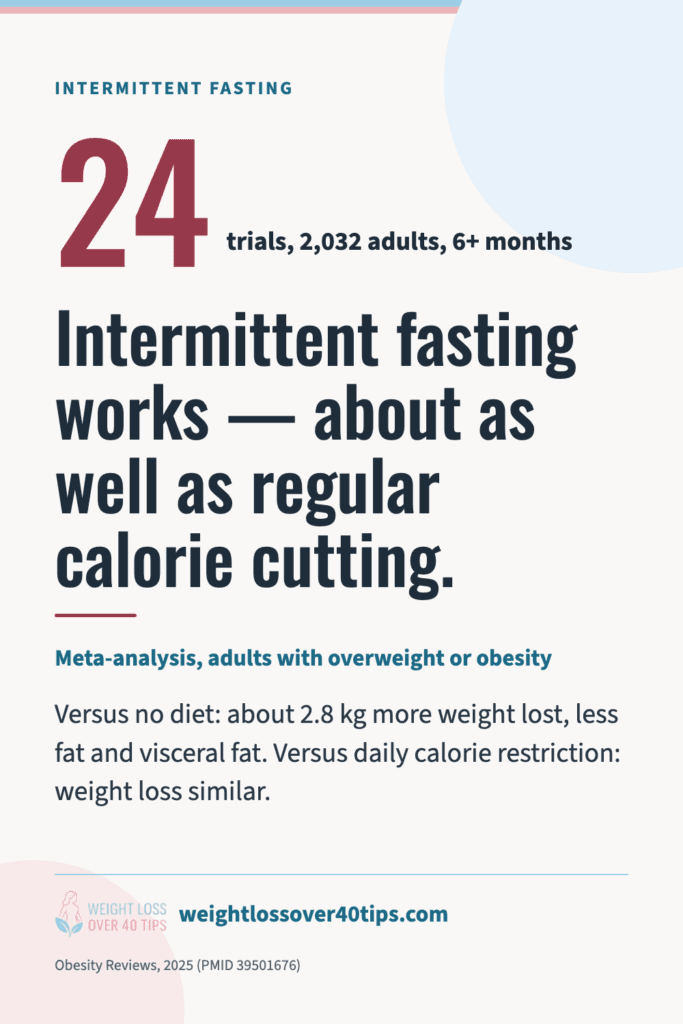
- Weight and body fat: A 2025 meta-analysis of 24 trials in Obesity Reviews found that intermittent fasting reduced weight, fat mass, waist size and visceral fat compared with no diet, and worked about as well as regular calorie restriction.
- Flexibility: Because it focuses on timing, it can be combined with most healthy eating patterns.
- No special belly-fat effect: Fasting reduces visceral fat mainly by helping you eat less; it does not target belly fat more than other ways of cutting calories.
- Simplified eating: Fewer meals means less time planning, prepping, and thinking about food — a genuine quality-of-life improvement.
Warning Signs: Intermittent Fasting Women Over 40: When to Stop Fasting
Stop intermittent fasting and consult your doctor if you experience:
- Hair loss or thinning
- Worsening sleep or insomnia
- Irregular or missed periods (if still menstruating)
- Increased anxiety or irritability
- Constant coldness or low body temperature
- Loss of menstrual cycle
- Binge eating during eating windows
- Persistent brain fog or fatigue after 2+ weeks
These are signs that fasting is too aggressive for your body. Scale back to a shorter fast or take a break entirely.
A Sample Week of IF for Women Over 40
| Day | Fasting? | Eating Window | Notes |
|---|---|---|---|
| Monday | ✅ 14:10 | 8 AM – 6 PM | High protein breakfast |
| Tuesday | ✅ 14:10 | 8 AM – 6 PM | Strength training day |
| Wednesday | ❌ Normal | Eat when hungry | Rest day — eat breakfast freely |
| Thursday | ✅ 14:10 | 8 AM – 6 PM | Walking day |
| Friday | ✅ 14:10 | 8 AM – 6 PM | Active day |
| Saturday | ❌ Normal | Eat when hungry | Social day — enjoy flexibility |
| Sunday | ✅ 14:10 | 8 AM – 6 PM | Meal prep for the week |
Combining IF With the Right Nutrition Plan
Intermittent fasting tells you when to eat — but what you eat matters just as much. During your eating windows, focus on whole foods, lean proteins, healthy fats, and plenty of vegetables.
If you need structure beyond IF, consider pairing it with:
- The Smoothie Diet — Nutrient-dense smoothie meals fit perfectly into a compressed eating window. Replace 1-2 meals during your eating hours with balanced smoothies.
- Noom — The psychology-based approach helps you build healthy eating habits that complement your IF schedule.
Additional programs that pair well with intermittent fasting: WW (Weight Watchers) for flexible tracking, Reverse Health for personalized guidance, and Dr. Kellyann’s bone broth fasting protocol. For meal replacements and nutrition support, see our Huel review and AG1 greens review.
👉 Explore all programs for women over 40
📥 Free Download: 7-Day Meal Plan for Women Over 40
High-protein, hormone-supporting meals + complete shopping list. Designed specifically for your body after 40.
Get the Free Meal Plan →Want more weight loss strategies? Explore our best weight loss programs for women over 40, learn about the best diet for women over 40, or try walking for weight loss.
For intermittent fasting women over 40, starting with a 14:10 schedule (14 hours fasting, 10 hours eating) is safer than jumping straight to 16:8. This gentler approach gives you time to adjust. After 2-3 weeks, you can gradually extend the fasting window if you feel comfortable.
If you want the eating windows planned for you: Reverse Health builds a fasting schedule around your age and hormones instead of a one-size protocol, which matters more after 40 than most fasting guides admit. The quiz is free. Take the free quiz → We earn a commission if you buy or sign up through our link.
Frequently Asked Questions
For the latest research on fasting and aging, the National Institute on Aging provides helpful resources for women over 40.
The Bottom Line
Intermittent fasting can be a useful tool for some women over 40. Start gentle with 14:10, don’t fast every day, prioritize protein, and listen to your body. The goal isn’t to push through hunger and misery. It’s to find a sustainable eating rhythm you can maintain.
If you try IF and it doesn’t feel right after 2-3 weeks of consistent effort, that’s okay. It’s not for everyone. Focus on whole foods, portion control, and regular movement instead. There are many paths to healthy weight loss after 40.
Related reading:
- How to Lose Weight After 40: Complete Guide
- Best Weight Loss Programs for Women Over 40
- Smoothie Diet vs Noom: Which Is Better?
- Why Is It So Hard to Lose Weight After 40?
- Menopause Weight Gain: What You Can Do
- Walking for Weight Loss Over 40
- Intermittent Fasting for Women Over 40
- Sleep and Weight Loss After 40
- Keto vs Mediterranean Diet for Women Over 40
Disclaimer: This article is for informational purposes only and does not constitute medical advice. Intermittent fasting may not be appropriate for everyone, especially those with a history of eating disorders, diabetes, or other medical conditions. Always consult your healthcare provider before starting any new eating pattern.
Get Your Free 7-Day Meal Plan
Join women over 40 getting weekly weight loss tips, meal plans, and honest program reviews.