Short answer: Choose Tai Chi if balance and steadiness are your main concern, Chair Yoga if stiffness, joint pain or an unsteady start means you want to stay seated, and Pilates if you’re already moving fairly comfortably and want core and strength work on a mat. All three are low-impact, beginner-level programs inside the same Reverse Health app and subscription. The research supports what each one can realistically do (better balance, mobility and modest body-composition changes), but none of them is a fast weight-loss tool on its own.
This review is based on Reverse Health’s public program pages, its quiz, its terms of service, its app store listings and published research. We have not tested these three programs ourselves. For the app as a whole, including the meal plans, see our full Reverse Health review.
The three programs at a glance
| Tai Chi | Chair Yoga | Pilates | |
|---|---|---|---|
| Best for | Balance, steadiness, gentle daily movement | Stiff joints, limited mobility, starting from zero | Core strength, posture, toning on a mat |
| Intensity | Very gentle (a fully seated option appears in the quiz) | Very gentle, seated or holding a chair | Gentle to moderate, low-impact, no jumping |
| Equipment | None | A sturdy chair | A mat; bands or small weights optional |
| Time per day | “10–15 minutes a day” (quiz) | 15–30 min sessions, 3–5×/week (FAQ) | 5–23 min sessions, 3–5×/week (FAQ) |
| Price | From $7.14 for the first week; 12 weeks $26.77, then $68.65 per 12 weeks | Same plan prices as Tai Chi (seen in euros); 4 weeks 15.65, then 40.12 per 4 weeks | From $7.14 for the first week; 4 weeks $15.65, then $44.13 per 4 weeks |
| Link | Take the Tai Chi quiz | Take the Chair Yoga quiz | Take the Pilates quiz |
We earn a commission if you buy or sign up through our links. As of October 2026, Reverse Health doesn’t publish a price list. The price appears at the end of the quiz and depends on your location, language and plan. On the Tai Chi offer screen we checked on October 27, 2026, the first week cost $7.14 and a 12-week plan $26.77, renewing at $68.65. See the cost section for details.
Time and equipment details come from Reverse Health’s own Chair Yoga and Pilates program pages and its public Tai Chi quiz.
How the quiz works (it’s the same for all three)
Each program starts with a short quiz. The first screen varies by version: some open with an age band (40–45, 46–55, 56–65, 65+ on the current Chair Yoga and Pilates pages), others with your body type. The public Tai Chi quiz then asks about your goals, any back, knee or hip problems, your preferred intensity and workout length, your height and weight (for BMI), and your sleep. It asks for your email before it shows your plan and the offer. One detail we liked: if your BMI comes out under 18.5, the quiz says it doesn’t recommend weight loss. After you sign up, you download the app and find the sessions in its Fitness tab.
Tai Chi: best for balance and steady, gentle movement
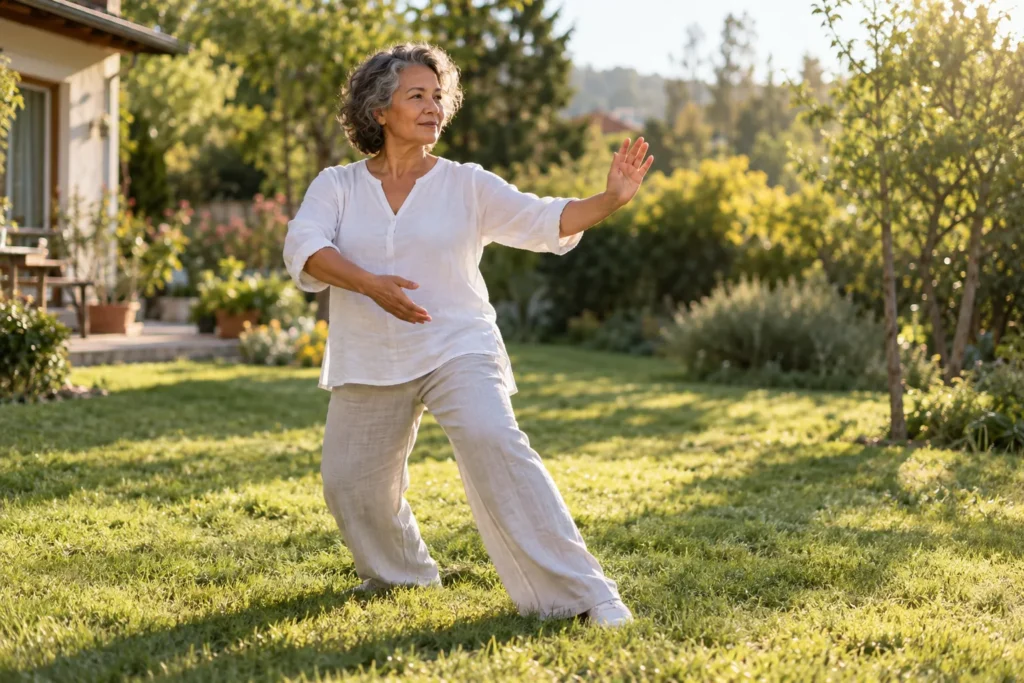
What it is. Slow, continuous, weight-shifting movement combined with breathing. Reverse Health describes its plan as beginner-friendly and guided, with no gym or equipment needed. The quiz also mentions a “Chair Tai Chi” version that is done fully seated.
What the research says.
- Falls and balance: the strongest evidence of the three. A Cochrane review of exercise for preventing falls found that tai chi may reduce the rate of falls by 19% (low-certainty evidence) and reduces the number of people who fall by 20% (high-certainty evidence, 8 trials, 2,677 participants) (Sherrington et al., Cochrane Database Syst Rev, 2019). Keep in mind who was studied: people aged 60+, with an average age of 76. A later meta-analysis of 24 trials in older adults also found fewer falls and better balance-test scores, with bigger effects from longer and more frequent practice (Chen et al., Front Public Health, 2023).
- Weight and body composition: modest. A review of 24 trials of tai chi and qigong found a small-to-medium effect on body composition (mostly BMI) in the 12 trials that compared it with doing nothing. Only 41.7% of the individual studies showed a significant improvement, and results varied widely (Larkey et al., Int J Behav Med, 2018).
- Joints: the U.S. National Center for Complementary and Integrative Health (NCCIH) notes that 2019 American College of Rheumatology/Arthritis Foundation guidelines strongly recommend tai chi for knee and hip osteoarthritis, and that tai chi appears to be safe (NCCIH).
Good fit if: you feel less steady than you used to, you want something calming you can do every day, or high-effort workouts leave you drained.
Not the best fit if: your main goal is building muscle or losing weight quickly. Tai chi supports those goals, but it doesn’t replace strength training (see our strength training guide for women over 40).
Chair Yoga: best when standing exercise isn’t comfortable yet

What it is. Yoga poses done seated or holding a chair for support. Reverse Health calls it a 28-Day Chair Yoga Challenge. It says sessions usually last 15–30 minutes, recommends 3–5 sessions a week, and says all you need is a sturdy chair.
What the research says. The studies are smaller and mostly in people older than our typical reader, so it’s worth reading them carefully:
- In a pilot randomized trial of 131 older adults with lower-body osteoarthritis who could not take part in standing exercise, 8 weeks of chair yoga reduced pain, pain interference and fatigue, and improved walking speed. However, only the drop in pain interference lasted 3 months, and chair yoga had no effect on balance (Park et al., J Am Geriatr Soc, 2017).
- A larger UK trial of 454 adults aged 65+ with several chronic conditions found that a 12-week chair-based yoga program was safe and well accepted. It did not significantly improve quality of life, mood, loneliness or falls (Tew et al., Health Technol Assess, 2024).
- A systematic review of 33 yoga trials in adults 65+ (many of them chair-based) found moderate-certainty evidence that yoga improves walking speed and leg strength compared with inactive controls. It may not outperform other exercise (Loewenthal et al., Ann Intern Med, 2023).
Good fit if: you’re starting from very little movement, you have sore knees or hips, or you’re nervous about your balance.
Not the best fit if: you’re already active. Some app users say the workouts feel too easy (more on reviews below). Also, don’t expect much weight change from chair yoga alone.
Pilates: best for core strength and posture
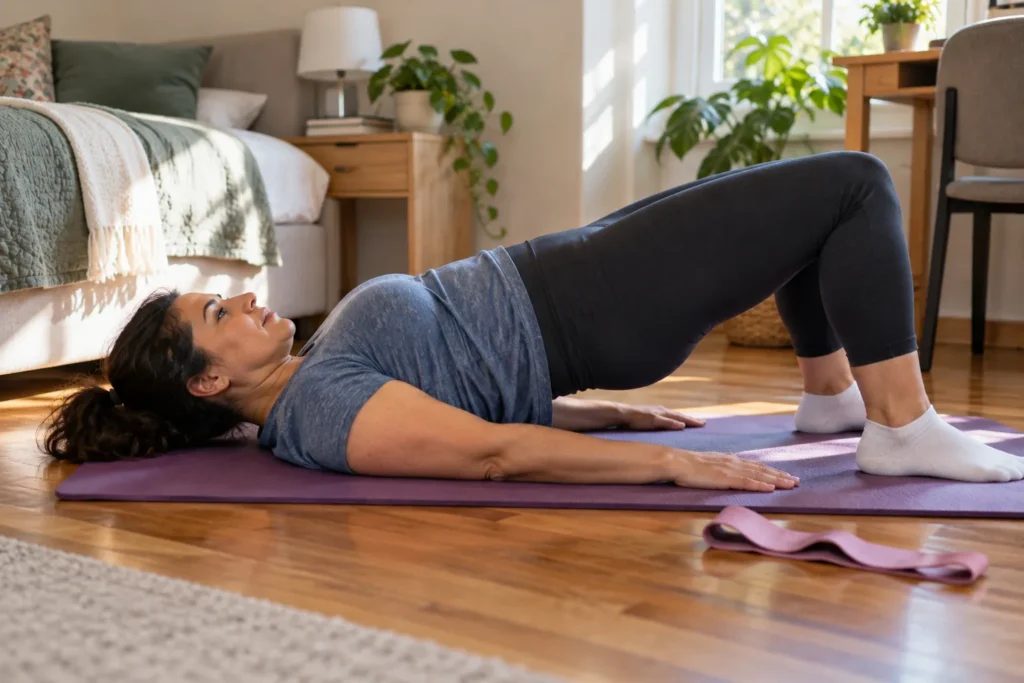
What it is. Low-impact, strength-based core and glute work. Reverse Health’s Pilates page lists a mat as the main equipment, with resistance bands or small weights as optional extras. Its FAQ says sessions run 5–23 minutes and recommends 3–5 sessions a week. The page also promises “visible results in just 4 weeks.” That is the company’s marketing claim, and we have no way to check it.
What the research says. The findings are mixed, and the way they’re mixed is useful to know:
- A 2026 meta-analysis of 12 studies in adult women found that Pilates lowered BMI and body weight (about 4 kg on average) and improved flexibility, but found no significant pooled effect on body-fat percentage, waist circumference or lean mass (Bajčetić et al., Sports, 2026).
- In adults with overweight or obesity, a meta-analysis of 11 trials (393 people) found reductions in body weight, BMI and body-fat percentage, but again none in waist circumference (Wang et al., Front Physiol, 2021).
- A third review found that mat Pilates was no better than other exercise or control groups at changing body composition (Cavina et al., J Phys Act Health, 2020).
Put together: Pilates can be a pleasant, sustainable way to get stronger and more flexible, and it may help a little with weight. Don’t count on it to shrink your waist by itself.
A note on the pelvic floor. Pilates works the deep core, but it isn’t the same as targeted pelvic floor muscle training. If leaking when you cough or lift is your concern, that training has the strongest evidence: in a Cochrane review, women with stress incontinence who did it were about eight times more likely to report a cure than those who didn’t (56% vs. 6%) (Dumoulin et al., Cochrane Database Syst Rev, 2018). A pelvic floor physical therapist can show you how.
Good fit if: you can get down to a mat and back up comfortably, and you want short, structured strength sessions.
Not the best fit if: getting up from the floor is hard right now (start with Chair Yoga), or you have osteoporosis or a recent back injury and haven’t yet asked a clinician which movements to avoid.
How much does it cost?
As of October 2026:
- No public price list. The price appears on the offer screen at the end of the quiz, before you enter card details. It depends on your location, language and the plan length you choose.
- What the Tai Chi offer showed (October 27, 2026, US dollars). With an introductory discount applied, three plans: 1 week $7.14 for the first week (regular $18.30), 4 weeks $15.65 (regular $40.12) and 12 weeks $26.77 (regular $68.65). The 12-week plan is pre-selected as “Best Value.” The fine print says the introductory price converts to a regular subscription — $68.65 per 12 weeks — unless you cancel before the renewal date. The screen also shows a countdown timer on the discount; don’t let it rush you, and read the renewal line before you pay. – The Chair Yoga offer (October 27, 2026) showed the same three plans with the same figures — 7.14, 15.65 and 26.77, regular 18.30, 40.12 and 68.65 — but in euros, because we viewed it from Europe, with the 4-week plan pre-selected as “Most Popular.” Its fine print says the 4-week plan renews at the regular price for 4 weeks unless you cancel. In other words, whichever plan you pick, after the introductory period you pay that plan’s regular price for each new period.
- The Pilates offer (October 27, 2026, US dollars) had the same introductory prices — $7.14, $15.65 and $26.77 — but higher regular prices: $20.13 a week, $44.13 per 4 weeks and $75.52 per 12 weeks, shown as a 65% discount. The 4-week plan was pre-selected, and its fine print says it renews at $44.13 for 4 weeks unless you cancel.
- Bottom line on price: across all three programs the introductory price was the same; what differs is the regular price you pay once it renews. Before you pay, check which plan is pre-selected and read the renewal line.
- App store prices are different. The App Store listing shows in-app purchases from $4.99 to $76.99, including a Pilates program at $19.99. Both the App Store and Google Play listings say that app access requires a paid subscription and that no free trial is offered there. The discounted trial is part of the web quiz offer.
- It’s a subscription. Under Reverse Health’s terms of service, subscriptions renew automatically unless you cancel before the renewal date. One-time “lifetime” purchases are the exception.
- Separate products. The fitness programs are sold separately from the nutrition plan covered in our main review. Check what your offer includes before you pay.
How to cancel. If you subscribed on the website, use “Manage my Subscription” under My Account (the offer screen’s fine print points there) or email the support address listed in the terms. If you subscribed through Apple or Google, cancel in your app store settings at least 24 hours before your renewal date. Either way, you keep access until the end of the period you’ve paid for. Set a calendar reminder the day you sign up.
The money-back guarantee has conditions. Reverse Health’s “30-Day Money Back Guarantee” covers the subscription only if, within your first 30 days, you log in every day for 14 days in a row and log a workout or a meal on at least 7 of those days. You then need to request the refund within 35 days of purchase and send screenshots as proof. Add-on personal coaching is non-refundable (terms, sections 9–10).
Is Reverse Health legit? What reviews and complaints say
Yes, it’s a real company. The apps are published by ReverseGroup Sia on both major app stores, and the terms of service and refund rules are public. As of October 27, 2026, the app is rated 4.3 out of 5 from about 9,500 ratings on the App Store, 4.4 from about 15,700 reviews on Google Play, and 3.8 from about 14,000 reviews on Trustpilot, where around one in five reviews is one-star.
Recurring themes:
- Praise: reviewers often call the low-impact workouts, including Pilates and chair yoga, clear and doable. Several mention helpful, fast-responding support, including refunds being sorted out.
- Complaints: the most common is billing: people saying they didn’t realize it was a recurring subscription, or that charges continued. Next come technical problems (the app stuck on loading or crashing). Some reviewers say the workouts are too easy if you’re already fit. App Store reviewers also note that the app doesn’t sync with fitness trackers such as an Apple Watch.
Our take: the programs themselves draw fewer complaints than the billing does. If you sign up, read the offer screen carefully, note the renewal date, and cancel early if it isn’t for you.
Free alternatives worth trying first
If money is tight, or you just want to see whether you enjoy the format, try these first:
- Tai chi: NCCIH’s tai chi overview explains what the research supports and points out that tai chi instructors aren’t licensed and there is no national certification standard, so ask about a teacher’s training. Senior centers, community centers and parks departments often run low-cost classes.
- Chair yoga: free follow-along videos are easy to find online. Choose one taught by a certified yoga teacher or physical therapist, and stop any pose that causes sharp pain.
- Pilates and strength: our strength training guide and best exercises for weight loss after 40 cover what you can do at home for free.
What a paid program adds is structure: a daily plan, tracking and reminders. For some women that’s the missing piece. For others, a free class twice a week works just as well.
Frequently asked questions
How much do Reverse Health Tai Chi, Chair Yoga and Pilates cost?
There’s no public price list; the price is shown at the end of the free quiz, before you pay. On October 27, 2026, the Tai Chi offer showed $7.14 for the first week, $15.65 for 4 weeks or $26.77 for 12 weeks, with the 12-week plan renewing at $68.65 per 12 weeks. Chair Yoga showed the same figures, and Pilates the same introductory prices with higher renewals (for example $44.13 per 4 weeks). All three programs are subscriptions that renew until you cancel.
Is Reverse Health legit or a scam?
It’s a legitimate company with public terms, a refund policy and apps on both major app stores, rated 4.3 (App Store) and 4.4 (Google Play) as of October 2026. The most common complaints are about recurring charges, so check the renewal date on your offer screen.
Are these programs OK for complete beginners?
Yes, all three are designed for beginners. If you’re unsure where to start, Chair Yoga is the gentlest, Tai Chi comes next and Pilates is the most demanding. If you have a heart condition, osteoporosis, recent surgery or balance problems, check with your doctor or a physical therapist first.
Is the Reverse Health Pilates program “wall Pilates”?
Reverse Health’s own pages and the App Store call it “Wall Pilates,” and that’s the name most people search for. Some exercises use a wall for support, but not every exercise needs one. The program is mainly mat-based, with optional bands or small weights.
Which one is best for weight loss?
None of them is a weight-loss program on its own. In studies, Pilates shows the clearest (still modest) effect on body weight and BMI, and tai chi a small one. You’ll see more change when you pair any of them with strength work and changes to what you eat. See how to lose weight after 40.
Sources
- Sherrington C, et al. Exercise for preventing falls in older people living in the community. Cochrane Database Syst Rev. 2019. https://pubmed.ncbi.nlm.nih.gov/30703272/
- Chen W, et al. Tai Chi for fall prevention and balance improvement in older adults: a systematic review and meta-analysis. Front Public Health. 2023. https://pubmed.ncbi.nlm.nih.gov/37736087/
- Larkey LK, et al. Body composition outcomes of Tai Chi and Qigong practice: a systematic review and meta-analysis. Int J Behav Med. 2018. https://pubmed.ncbi.nlm.nih.gov/29856007/
- Park J, et al. A pilot randomized controlled trial of the effects of chair yoga on pain and physical function among community-dwelling older adults with lower extremity osteoarthritis. J Am Geriatr Soc. 2017. https://pubmed.ncbi.nlm.nih.gov/28008603/
- Tew GA, et al. Chair-based yoga programme for older adults with multimorbidity: RCT. Health Technol Assess. 2024. https://pubmed.ncbi.nlm.nih.gov/39259017/
- Loewenthal J, et al. Effect of yoga on frailty in older adults: a systematic review. Ann Intern Med. 2023. https://pubmed.ncbi.nlm.nih.gov/36913687/
- Bajčetić Č, et al. Effects of Pilates programs on body composition, flexibility, muscular strength … in adult women: a systematic review and meta-analysis. Sports (Basel). 2026. https://pubmed.ncbi.nlm.nih.gov/42784403/
- Wang Y, et al. Pilates for overweight or obesity: a meta-analysis. Front Physiol. 2021. https://pubmed.ncbi.nlm.nih.gov/33776797/
- Cavina APS, et al. Effects of the mat Pilates method on body composition: systematic review with meta-analysis. J Phys Act Health. 2020. https://pubmed.ncbi.nlm.nih.gov/32396869/
- Dumoulin C, et al. Pelvic floor muscle training versus no treatment, or inactive control treatments, for urinary incontinence in women. Cochrane Database Syst Rev. 2018. https://pubmed.ncbi.nlm.nih.gov/30288727/
- NCCIH. Tai Chi: What You Need To Know. https://www.nccih.nih.gov/health/tai-chi-what-you-need-to-know
- Reverse Health: Chair Yoga program page https://reverse.health/product/chair-yoga · Pilates program page https://reverse.health/product/wall-pilates · Tai Chi quiz https://tour.reverse.health/fitness-taichi-us-home · Terms of Service https://reverse.health/legal/terms-of-service (all accessed October 2026)
- App Store listing: https://apps.apple.com/us/app/rh-weight-loss-and-fitness/id6464588020 · Google Play listing: https://play.google.com/store/apps/details?id=reverse.health.app · Trustpilot: https://www.trustpilot.com/review/reverse.health (accessed October 27, 2026)
Medical disclaimer: This article is for general information only and isn’t medical advice. Talk to your doctor or a physical therapist before starting a new exercise program, especially if you have heart disease, osteoporosis, joint problems, pelvic floor symptoms or a history of falls. Individual results vary.
Are you a woman over 40? Help us build an honest picture of weight after 40: take our 2-minute anonymous survey. We will publish the combined results on this site.
Get Your Free 7-Day Meal Plan
Join women over 40 getting weekly weight loss tips, meal plans, and honest program reviews.